
Welcome to the G7IZU Radio Reflection Detection website
This site deals mainly with radio propagation and space weather “now casting”. I try not to make many predictions as predictions are notorious for being wrong! My blog pages contain occasional ramblings that you may find interesting (scroll down the left info bar to find them).
See my Learn about Space Weather page (on this site) for a concise and factual introduction to space weather.
NOTICE: Please do not link my map images directly into dashboards etc. My web hosting will not handle the load of hundreds of simultaneous connections!
You can follow me @g7izu@universeodon.com the Mastodon social network for breaking events in the world of space weather and radio propagation. I regularly report on solar flares, geomagnetic storms and radio propagation.
The page links are on the left-hand sidebar if you’re using a large screen, or touch the menu tab at the top right on mobiles. Tapping the cog on the left opens the information sidebar which contains live propagation warnings and other solar information. On larger screens the sidebar is always visible.
The map size on the propagation map pages have been reduced slightly, but clicking on the map will open it in a new tab for a detailed view in full size.
Dr. Tamitha Skov
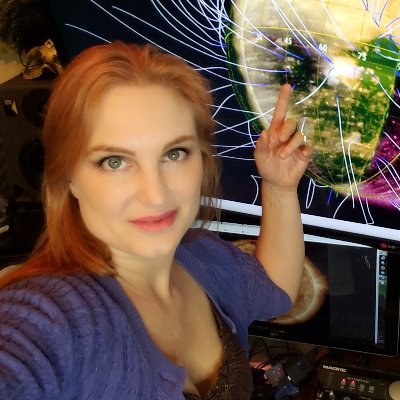
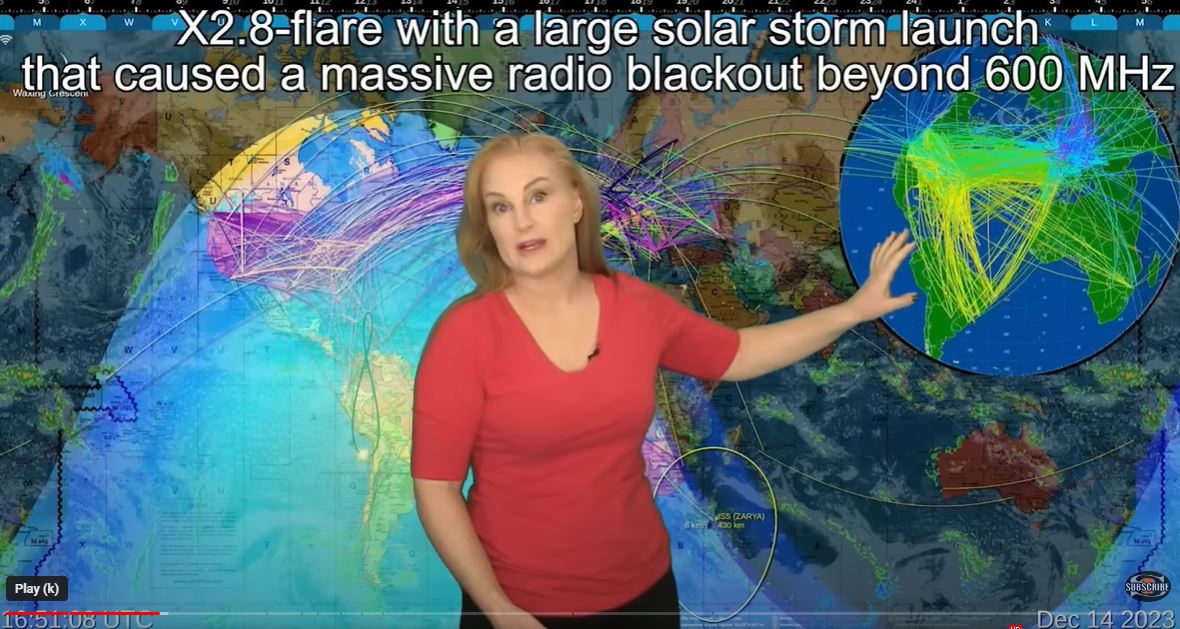
With my permission, original material from this website is used by the “Space Weather Woman”, Dr. Tamitha Skov, in the space weather forecasts she presents on her Patreon and Youtube channels. Material also appears in occasional lecture material she presents at or on behalf of Millersville University, also in corporate and societal presentations given to members of business, authorities and the public.
Read more about Dr. Skov here: https://www.spaceweatherwoman.com/.
In May 2025 Tamitha presented this 4½ hour “mini-course” looking at the causes and effects of the Gannon Geomagnetic Storm (10-13 May 2024). Products from this website were included in the course.

The Sporadic-E Phenomenon
Sporadic-E, or simply “Es”, is mostly a summertime phenomenon, peaking between May and September in the northern hemisphere, and October and March in the southern hemisphere.
The causes of Es are not well understood and there and many theories, although it’s known that high levels of ionisation in the E-layer (80-120km altitude) cause radio waves to refract over long distances. A single hop can be somewhere between 400 and 2400km. Multiple hops are possible and in combination with F2 propagation, global communication on the 50 MHz band is know to occur. The Es “clouds” are sporadic in nature and can happen anywhere and at any time, although they are most common in the local summer with a late morning peak and a late afternoon peak. Extreme events can last several days and span the globe, or be localised to continents. Small isolated Es clouds can add to the magic, providing surprise contacts between specific locations.
HF Propagation and solar activity
This is a subject too big to put in full here, but in a nutshell the radio frequencies between 0 and approximately 30 MHz can be reflected from the various layers of the ionosphere to a greater or lesser extent at different frequencies. Under good conditions the propagation can allow signals to travel half-way (even all the way or multiple times) around the world, but the frequency bands for the best propagation change hourly and by season, and are dependent on the amount of incident sunlight and current level of solar activity. During a solar storm (when the sun blasts out charged particles, and radio noise and X-Rays) these layers can be ionized to a much greater extent than is normally the case. The signals can then be blocked from escaping far enough from the Earth’s surface and not make it up to the higher layers for onward propagation around the globe. This is called a “radio blackout” which mostly affects the HF bands. HF bands and higher frequencies up into VHF, UHF and SHF can also be affected by high levels of broadband noise which can last seconds, minutes or hours, and can come in rolling waves or as single bursts.

My HF radio propagation maps can track radio blackouts. At onset of a blackout, the lower frequencies will be attenuated first, then as the blackout intensity increases higher and higher frequencies become attenuated. Blackout can last minutes or many hours in duration. The recovery time is dependent on the strength of the storm. Follow my Mastodon and Bluesky feeds for live updates during solar storms.
If you see any problems with the website or have any suggestions for things you would like to see, please get in touch.
Andy Smith, G7IZU
Devon, England, British Isles, Earth…
Keep up to date:
Mastodon social network @g7izu@universeodon.com
Bluesky social network @g7izu.bsky.social
Note: Site-wide comments are disabled due to misuse.
I can be contacted via the Mastodon social network @g7izu@universeodon.com or via email andy <at> tvcomm.co.uk